
Blended Learning
Digital Workshop
A scenario-based, team-driven practical application experience preparing learners for report-building certification.
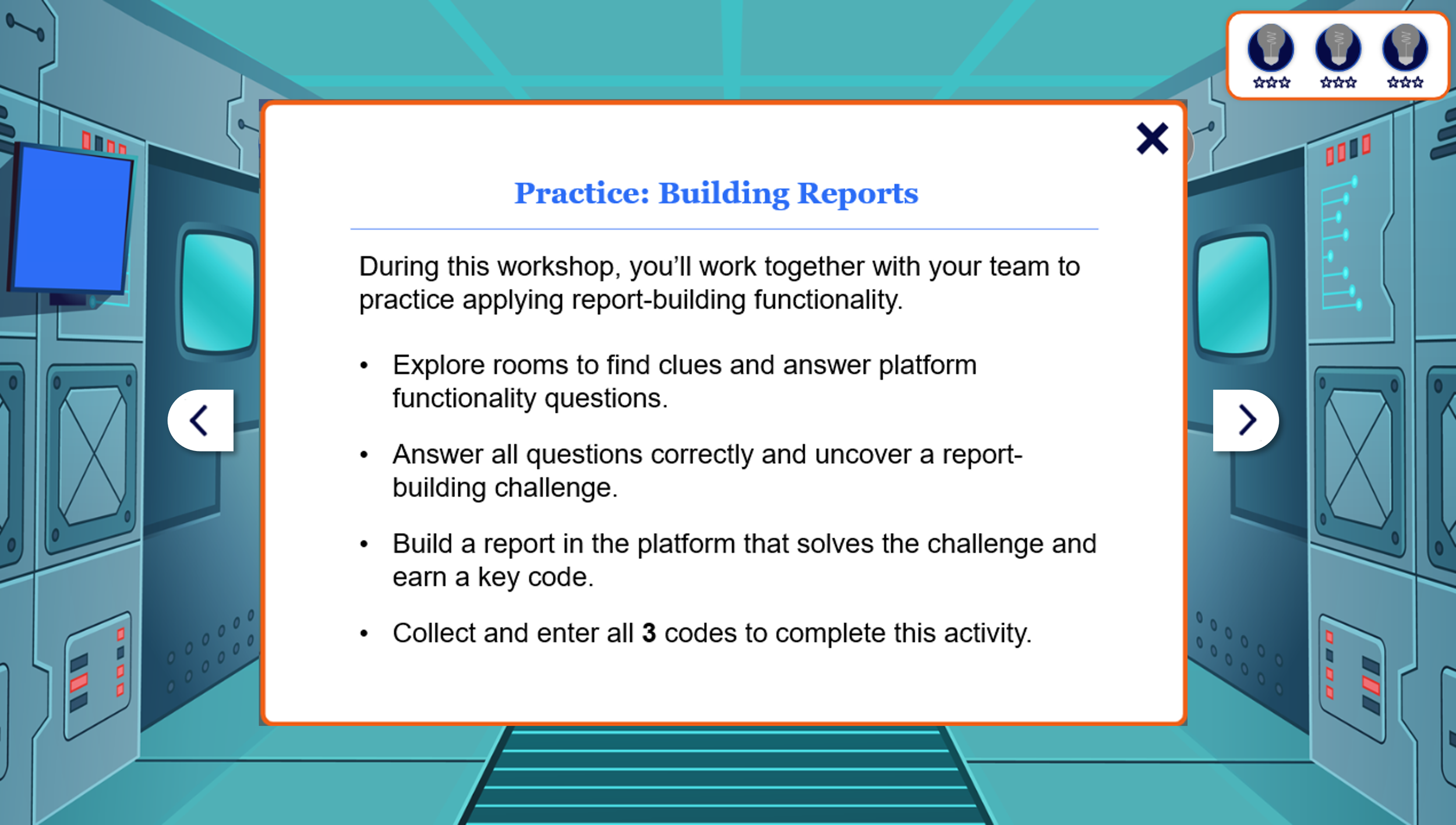
Project Overview
This immersive digital workshop served as the practical application component of a multi‑phase report‑building certification program. Learners entered a themed, story‑driven environment where they tackled realistic reporting challenges modeled directly after real client scenarios.
The experience blended scenario‑based eLearning, collaborative team problem‑solving, and expert facilitation. Participants navigated a cohesive narrative, engaged in branching activities and knowledge checks, and applied their skills to authentic data analysis tasks. Trainers supported live sessions, guiding learners through the analytic process and assessing performance.
Early pilot results reflected strong impact, with 92% of participants self‑rating as competent or highly competent and 100% of facilitators reporting positive program effectiveness
Audience
Client teams
Tools Used
Articulate Storyline, Microsoft Word, PowerPoint, Asana
Responsibilities
Led the design and development of the practical application (digital workshop) phase
Created scenario‑based, interactive modules with embedded resources, knowledge checks, and branching activities
Designed gamification elements including badges, progress tracking, and instant feedback
Partnered with trainers to align facilitation and assessment strategies
Supported pilot facilitation and learner engagement
Collaborated closely with a developer, directing instructional design, content, and overall learning strategy
Documented recommendations for full rollout following the pilot phase
Note: Original materials cannot be shared due to company confidentiality. Any visuals shown are masked.
The Challenge
The organization faced inconsistent and inefficient report‑building practices across teams, growing demand for formal recognition of analytics expertise, and limited opportunities for learners to apply skills in realistic contexts. Traditional training methods lacked hands‑on practice, real‑world application, and measurable skill validation. The company also aimed to generate new revenue through a premium, industry‑recognized certification program.
The Solution
My team developed a multi‑phase certification program consisting of:
Instructor‑Led Training (ILT): Foundational, facilitator‑led sessions to build baseline knowledge.
Practical Application Component (my role): An immersive, scenario‑based digital workshop where learners practiced solving real‑world reporting problems inside a cohesive, themed environment.
Competency Assessments: Formal assessments to validate mastery and award certification.
Within this structure, I was responsible for designing the Practical Application component — the bridge between foundational instruction and certification‑level performance.
My Process
Learning Theory and Model Integration
With the challenge defined and the solution established, I led the design and development of the immersive workshop using an evidence‑based instructional design process grounded in:
Merrill’s First Principles (authentic tasks, real‑world application)
Cognitive Load Theory (scaffolding, chunking, clarity)
Constructivism and Social Learning Theory (collaboration, peer reasoning)
Backward Design (alignment to certification‑level competencies)
These models guided decisions across each phase to ensure clarity, authenticity, and measurable skill transfer.
-
Identified the need for consistent, advanced report‑building skills and formal recognition of expertise.
Analyzed learner roles and workplace demands using andragogical principles to ensure relevance.
Identified performance gaps in engagement, skill transfer, and operational impact.
Used Backward Design to clarify certification‑level expectations and map required competencies.
-
Defined measurable learning objectives aligned to certification outcomes.
Designed an immersive, themed, scenario‑based workshop grounded in Constructivism and Social Learning Theory.
Applied Cognitive Load Theory through chunking, scaffolding, and clear guidance.
Used Merrill’s First Principles to anchor activities in authentic report‑building tasks.
Created storyboards and interaction flows using Multimedia Learning Principles.
Integrated gamification elements (badges, progress tracking, instant feedback).
-
Built scenario‑based activities, knowledge checks, and embedded resources aligned to real business reporting challenges.
Directed instructional design while collaborating with a developer on the Storyline build.
Conducted QA for usability, accessibility, and alignment to objectives.
Developed facilitator guides using Cognitive Apprenticeship to support expert modeling.
-
Led the pilot launch to validate flow, engagement, and scenario clarity.
Partnered with trainers to support facilitation and learner questions.
Monitored engagement through collaborative activities and gamification.
Documented recommendations for full rollout.
-
Conducted formative evaluation during the pilot to refine content and interactions.
Ensured assessments aligned with Backward Design and certification competencies.
Analyzed early indicators of engagement and skill application.
Outcome Indicators: Pilot results showed 92% of learners self‑rated as competent or highly competent, and 100% of facilitators reported positive program effectiveness.
Provided recommendations for continuous improvement and broader rollout.
Reflection: Project Takeaways
Key Learnings
Designing and piloting the practical application component reinforced the value of grounding learning in authentic, real‑world tasks. The immersive, themed environment — combined with scenario‑based challenges, cognitive scaffolding, and collaborative problem‑solving — created a meaningful bridge between foundational instruction and certification‑level performance. Strong competency gains and facilitator endorsement validated the effectiveness of the design
Enhancement Opportunities
1. Build in earlier, structured user testing cycle prior to pilot.
While the pilot offered valuable insights, future projects would benefit from earlier, iterative user testing during development. Short usability checks with a small learner group — before the full pilot — would help validate interaction patterns, cognitive load, and scenario clarity earlier in the process. This would accelerate refinement and reduce rework later in the cycle.
2. Formalize a more frequent cross-functional review cycle.
Collaboration with trainers and the developer was strong, but future projects could be strengthened by establishing a more formalized review cadence across SMEs, trainers, and technical partners. A recurring touchpoint (e.g., weekly design reviews) would ensure alignment, surface questions sooner, and create a shared sense of ownership throughout the build. This structure would also support smoother handoff if team transitions occur, as they did in this project.