

From Analysis to Action:
The Analytic Process
Turn data into decisions through a structured analytic framework.
Click below to see the high-level strategy behind this learning experience:
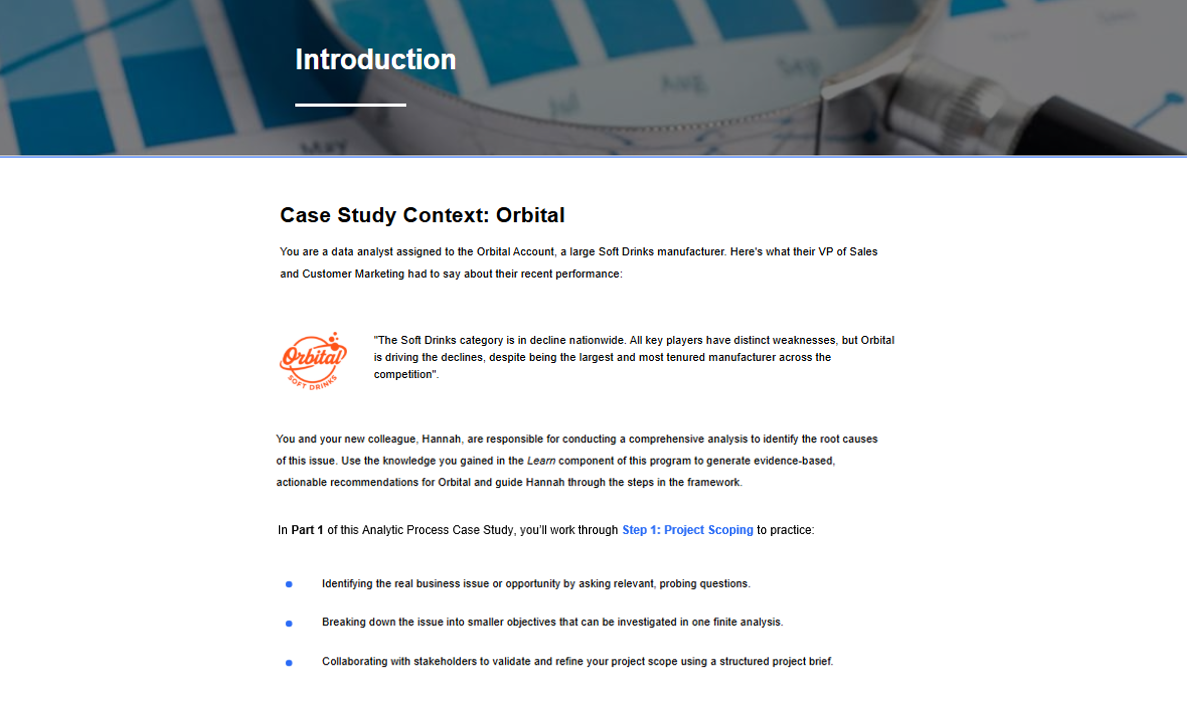
Audience
Customers (Manufacturers and Retailers)
Tools Used
Articulate Rise, Storyline, Microsoft Word, PowerPoint, Workday, Asana, Copilot
Note: Original materials cannot be shared due to confidentiality. Any visuals shown are masked mock‑ups.
The Challenge
Previous ILT sessions on the analytic process were shortened to fit time constraints, reducing depth and limiting practice. While the original design wasn’t flawed, the condensed format left learners without enough support to apply the process effectively.
This program was created to restore essential content, reinforce each step with structured guidance and practice, and reconnect the dots for learner success. It was also designed with a dual purpose: to serve as a scalable, revenue-generating offering for external customers.
The Solution
I designed an asynchronous eLearning program that taught the analytic process as a sequential four-phase framework:
Phase 1: Project Scoping (gather and organize all necessary information, define core issue, generate hypotheses and research objectives, validate scope with stakeholder)
Phase 2: Analysis Design (map analytical flow, set data parameters, confirm design feasibility)
Phase 3: Data Analysis (identify key findings and implications, build presentation slides and story)
Phase 4: Recommendation Development (and Delivery) (generate actionable recommendations, quantify opportunities, deliver analysis, outline next steps)
The program featured scenario-based modules, interactive case studies, and competency-based assessments. I streamlined existing ILT content, retaining what was effective and revising or replacing gaps. The final solution focused on what new learners needed to succeed, balancing clarity and efficiency while restoring depth and support that had been lost in earlier iterations. The first customer team to complete certification reported the program helped them deliver deeper data-driven recommendations and conduct proactive business issue analysis.
My Process
Instructional Theory in Practice
This project was grounded in:
Bloom’s Taxonomy — to define clear, foundational learning objectives.
Gagné’s Nine Events of Instruction — to structure the learning flow and support engagement.
Kirkpatrick Model for Evaluation — to ensure relevance, clarity, and immediate application.
These models guided decisions across each ADDIE phase to ensure the program was accessible, confidence‑building, and aligned with real‑world reporting tasks.
-
During the analysis phase, I reviewed stakeholder insights and evaluated existing ILT and asynchronous materials to identify gaps created by time constraints — determining what could be reused versus what needed to be rebuilt. I collaborated with SMEs to validate the scope, then built a project timeline and asset tracker in Asana to manage deliverables across a team of three designers and a developer.
-
Learning objectives were drafted against Bloom's Taxonomy and mapped to real-world actions learners would need to perform. I storyboarded both the Learn and Practice components and collaborated closely with SMEs to develop two distinct case studies — one updating an existing data story, one built from scratch around a new CPG business challenge. Copilot supported phrasing efficiency and quality checks throughout the design process.
-
I built the self-guided Rise modules and partnered with a developer on embedded Storyline blocks, ensuring seamless integration of interactive elements. When Articulate released custom blocks mid-development, I collaborated with the developer to incorporate them across Learn and Practice — modernizing the visual design and aligning it to company branding. All builds were shared in Review360 for final SME review before implementation.
-
I created structured LMS documentation and organized SCORM files in coordination with the LMS administrator to ensure clear access and smooth deployment. The program was sequenced to require Learn completion before Practice, culminating in the Grow/Achieve assessment for badge issuance. Participant guides and support resources were embedded at each stage to support learners throughout.
-
Formative evaluation was built into Learn and Practice via knowledge checks and feedback loops. Summative evaluation was carried out through competency tests in the Grow component. Level 3 post-training surveys indicated self-reported improvement in applying the analytic process. Level 4 data collection is ongoing post-release to assess long-term behavior change and business impact, but the first customer team to complete the certification program reported that it enabled them to improve their proactive business issue analysis and deliver deeper data-driven recommendations.
Gagné’s Nine Events of Instruction
Attention was gained through realistic business scenarios in Learn and Practice components and a high-stakes context in the Grow assessment. Learners were informed of clear objectives at the program start and reinforced in each component.
Recall of prior learning was stimulated by referencing personal experiences in Learn, recalling strategies from Learn in Practice module application, and building assessments on both.
Content was presented using structured frameworks and case studies presented progressively across components, while learning guidance was provided through participant guides, job aids, checklists, and embedded tips within the modules.
Performance was elicited via interactive activities, real-world case study application opportunities, and competency tasks, with immediate feedback in Learn and Practice, and final assessment scoring in Grow.
Performance assessment included knowledge checks and formal competency tests.
Finally, retention and transfer were enhanced through the learning guidance materials mentioned above, real-world application guidance, and downloadable summaries ensuring learners could apply skills effectively on the job.
Phase 1: Project Scoping
Focus: Define and frame the challenge; Learners clarify problems, generate hypotheses and define research objectives.
Bloom’s Levels: Understand > Analyze > CreatePhase 2: Analysis Design
Focus: Plan the analytical approach; Learners specify deliverables, map analytical flow, and validate design.
Bloom’s Levels: Apply > Analyze > EvaluatePhase 3: Data Analysis
Focus: Extract insights and build narrative for analysis presentation; Learners identify findings, build storyboards, and generate implications.
Bloom’s Levels: Apply > Analyze > Create > EvaluatePhase 4: Recommendation Development
Focus: Deliver strategic solutions; Learners propose actions, quantify impact, and present executive summaries.
Bloom’s Levels: Create > Evaluate > Apply
Bloom’s Taxonomy
The Kirkpatrick Model
At Level 1, internal learners rated the training highly on relevance and clarity during pilot.
Level 2 results showed strong assessment performance during internal pilot, with learners demonstrating solid proficiency.
Level 3 post-training surveys indicated self-reported improvement in applying the analytic process.
Level 4 evaluation is ongoing, with plans to collect data post-release to client audiences to assess long-term behavior change and business impact — the first customer team to complete certification reported the program helped them deliver deeper data-driven recommendations and conduct proactive business issue analysis.
Reflection: Project Takeaways
Collaboration
Throughout the course of this project, I had the opportunity to work with colleagues I hadn’t previously been partnered with. Not only did it allow me to get to know my teammates better, but also to gain a clear understanding of their working and learning styles, which was essential in us figuring out how best to approach this project end-to-end. Future collaboration will be that much more seamless, having this shared experience and familiarity, and not only benefits myself, but our entire team.
AI Integration
This was my first experience leveraging AI within an instructional designer context via Copilot — and it was awesome.
I learned so many strategies — from efficiency improvement hacks, to condensing complex language, to suggesting initial drafts that I could then refine with my ID expertise — and more. I’m excited to continue finding new ways to incorporate AI in my learning design and development process.
Custom Blocks (Rise)
Partway through the development of our Learn modules, Articulate Rise released their custom blocks feature. This was a game-changer for myself and the developer I worked closely with to build out all of the Learn and Practice eLearning.
We met to discuss on visual design changes we could to improve the learner experience, and aligned on specific styles and instances to use for custom blocks in the company branding throughout all modules. It modernized the look and feel of the program and I’ve continued to use them in Rise builds since.